
Down payments—upfront contributions paid by home buyers before financing the rest of the home with a mortgage—are an important part of home buying. A larger down payment usually leads to better loan terms (like lower interest rates) because the lender assumes less risk as their contribution is smaller. Conventional mortgages typically require at least 3% down and FHA-insured loans require 3.5% down. Buyers who put down less than 20% must pay mortgage insurance, which protects the lender until its share of the home’s value drops below 80%.
Down payment assistance, often from state or local government, can help buyers overcome the hurdle of not having 20% to put down. There are loan products that permit low or no down payments for buyers with lower incomes or who are members of specific populations (for example, 0% for veterans whose loans are guaranteed by the VA).
An October 2025 from Realtor.com highlights national home buying trends, with a particular focus on the rising cost of down payments (shown in Figure 1 below). The 2025 Q3 median down payment was $30,400, more than twice the 2019 Q3 figure of $13,900. Similarly, the average percentage of purchase price paid as down payment was 14.4% in 2025 Q3, up from 11.1% in 2019 Q3.
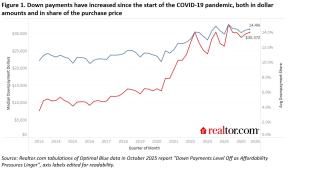
In addition, the average down payment share has fluctuated in recent years, ranging between 13.0%[i] and 14.9%[ii] between 2022 and Q3 2025, (see Figure 1). Geographically, down payments were highest in the Northeast (18.2% of the purchase price), followed by the West (16.3%), Midwest (14.5%) and South (12.5%). In 2024, the average down payment share of the purchase price in North Carolina was 14.2%[iii].
Down payment increases are in large part a function of home price increases. Home prices have risen over the last few years nationally and in North Carolina. Between Q3 2019 and Q3 2025, the median home sale price nationally increased 44.7%. Metro areas in North Carolina also saw large increases from October 2019 to October 2025, although less large: median listing prices increased 35.7% in the Virginia Beach-Norfolk-Newport News VA-MA MSA, 30.8% in the Charlotte-Concord-Gastonia NC-SC MSA and 25.5% in the Raleigh-Cary NC MSA[iv]. Down payment requirements that are a percent of the purchase price mean down payment amounts rise as the home prices rise. Increased home prices and a larger share used for down payments together contributed to the more-than-doubling of median down payment amounts. This paints a mixed picture: increased down payments can make home buying increasing inaccessible for first-time or low-income buyers, even as higher down payment percentages may improve buyer equity and loan stability.
Tools to Make Home Ownership More Accessible
In North Carolina the median home sales price was $380,000 in November 2025[v]. A down payment of 14.2% (the average in North Carolina in 2024) would be $53,960[vi], a substantial hurdle for many North Carolinians. The more money a buyer can put down for their home the more favorable mortgage terms they typically receive.
Saving cash for a down payment is a significant obstacle to home ownership, particularly for low-income buyers. Fortunately, government-backed mortgage programs available for low- and moderate-income home buyers often have mechanisms to help buyers overcome these down payment hurdles. Similar to the VA-guaranteed loans mentioned above, USDA’s Single-Family Housing Guaranteed Loan requires no down payment, provided the buyer meets credit score requirements. Several local governments across the state provide down payment assistance, helping buyers move closer to home ownership.
NC Housing Finance Agency Down Payment Assistance Options
The NC Housing Finance Agency’s home buyer programs have a number of provisions that allow greater access to home buying for low-income and first-time buyers, including down payment assistance, competitive interest rates, minimum credit score requirements and home buyer education. For down payment assistance specifically, the NC Home Advantage Mortgage™ provides qualified buyers with a 0% interest, forgivable loan of up to 3% of their mortgage loan amount for their down payment. In addition, the NC 1st Home Advantage Down Payment provides $15,000 in down payment assistance, also as a 0% forgivable loan, for qualifying first-time buyers and military veterans. The Community Partners Loan Pool provides eligible buyers up to 25% of the sales price or a maximum loan of $50,000 (whichever is less), which can be combined with the $15,000 NC 1st Home Advantage Down Payment.
Additional information about these programs and more can be found in NC Housing Finance Agency’s Affordable Housing is Our Business and on the Agency’s website, www.nchfa.com.
-------------------------
[i] In 2023 Q1. Hannah Jones, “Down Payments Fall From Recent Peak,” Realtor.com® Economic Research, May 11, 2023. Available here.
[ii] Hannah Jones, “Down Payments Ease in Q3, but Remain Near Recent Highs,” Realtor.com® Economic Research, Oct 22, 2024. Available here.
[iii] Hannah Jones, “Down Payments Climb in Northeast, Fall in South in 2024,” Realtor.com® Economic Research, Apr 9, 2025. Available here.
[iv] NCHFA calculations of figures from Realtor.com reports: Sabrina Speianu, “October 2019 Monthly Housing Market Trends Report,” Realtor.com® Economic Research, Oct 31, 2019. Available here; Jake Krimmel, “October 2025 Monthly Housing Market Trends Report,” Realtor.com® Economic Research, Oct 30, 2025. Available here.
[v] NC REALTORS' November 2025 NC Housing Report, available here.
[vi] NCHFA calculations from NC REALTORS' November 2025 NC Housing Report, available here.